Why Business Planning Can’t Happen in Silos
What does a healthy architecture practice actually require?
A clear sense of purpose. Financial literacy. An organizational structure that supports the work and the people doing it. Strong leadership. A thoughtful approach to marketing and business development. And, perhaps most importantly, an understanding of how all of those things affect one another.
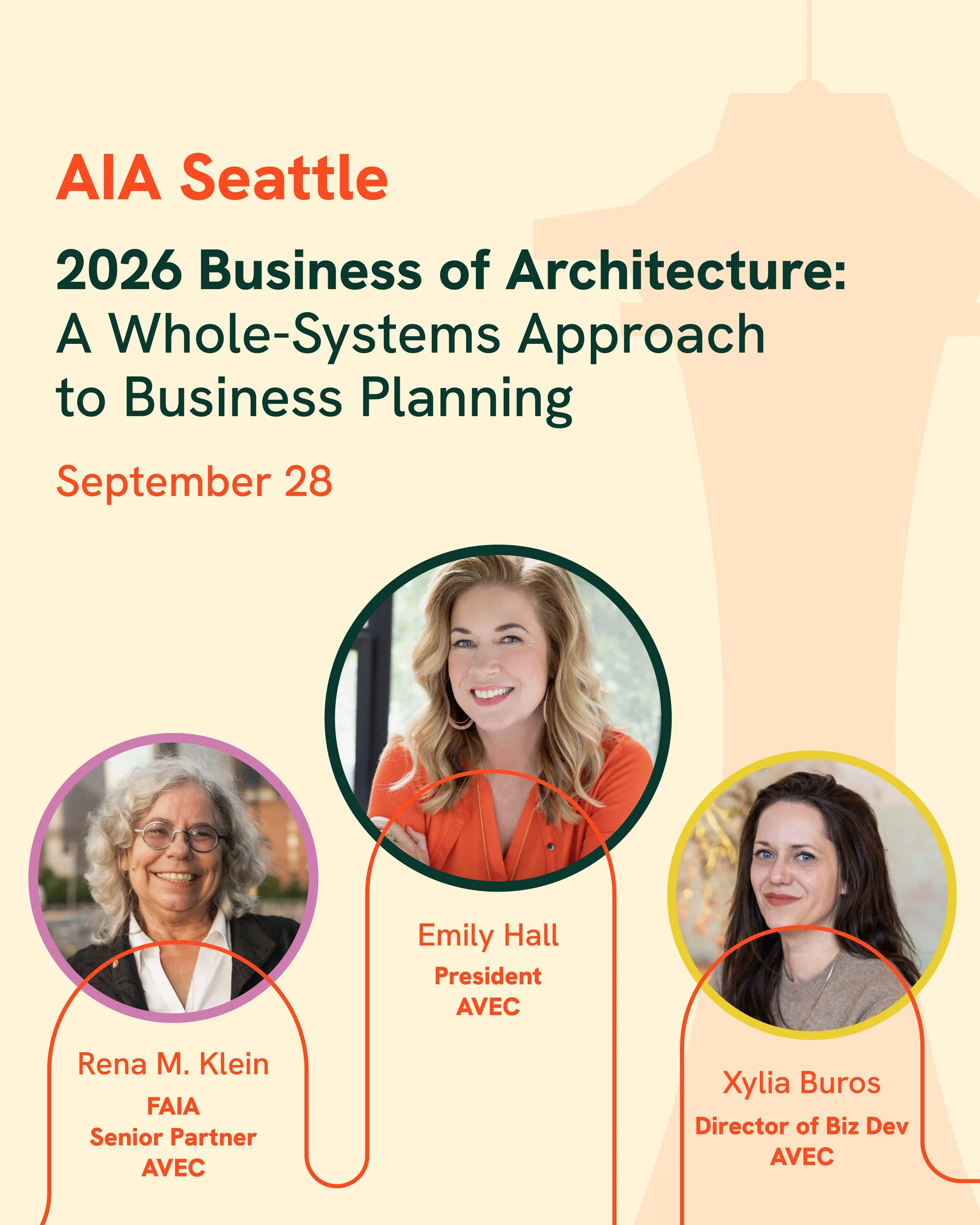
On September 28, Team AVEC is heading to Seattle to present A Whole-Systems Approach to Business Planning, a full-day AIA Seattle Business of Architecture workshop for new, emerging, and current firm leaders. Together, we’ll dig into the interconnected decisions that shape a successful practice—and give participants time and tools to apply what they’re learning to their own firms.
As AVEC Senior Partner Rena M. Klein, FAIA, puts it, “Too often we focus on what we enjoy—or are good at—while neglecting problem areas. In a whole-systems approach, a weak link is detrimental to the health of the whole firm.”
That idea will guide the day. Rather than treating strategic planning, finance, operations, and marketing and business development as separate conversations, we’ll look at what happens when you consider them together. A plan for growth has implications for staffing and leadership. Staffing decisions affect overhead and profitability. Entering a new market requires investment, positioning, relationships, and capacity to deliver the work. Even a strong pipeline can create problems if the firm doesn’t have the people, systems, or financial structure to support it.
The workshop will move from the big picture to practical application. We’ll start with firm purpose and the role mission, vision, and values play in business decisions, then dig into the financial fundamentals leaders need to understand where their firm is today and model where it could go next. From there, we’ll explore organizational structure, accountability, career development, project performance, and the operational systems that help firms translate strategy into action. The day will conclude with marketing and business development: how firms define what makes them different, identify the clients and work they want, build meaningful relationships, and create a realistic plan for bringing in the right opportunities.
And this is a workshop in the truest sense of the word. Participants won’t just listen to a day of presentations. They’ll work through exercises using our AVEC Business Planning Workbook, including developing a five-year financial pro forma, designing a career ladder, defining firm differentiators, and beginning to outline an integrated marketing and business development plan. The goal is to leave with ideas already on paper and a framework that can keep the conversation going back at the firm.
We’re particularly excited that AIA Seattle has designed the program for more than firm owners. The workshop is also intended for emerging leaders: people leading teams or practice groups, supervising others, making important decisions, and influencing culture and staffing. That matters, because business literacy shouldn’t begin the day someone becomes a principal. Understanding how people, projects, money, operations, and new work connect is part of learning how to lead a practice.
Business planning isn’t about predicting exactly what your firm will look like five years from now. It’s about developing a clearer picture of where you want to go, understanding what it will take to get there, and having a framework for making better decisions along the way.
If that’s a conversation your firm needs to be having, join Team AVEC and AIA Seattle on September 28 at the National Nordic Museum for A Whole-Systems Approach to Business Planning. Registration is open through September 24.